Best Starting Class & Profession in Romestead
Last updated: 2026-08-23
Your starting class sets your opening weapon and your skill bias for the first hour. It doesn't lock you out of anything — every character can learn every skill — but a good pick smooths out the first few in-game days. Below is our full tier list of all 8 professions, then exactly how each class plays. Already know your class and want a full playstyle plan? Jump to our character builds guide (mage, tank, DPS, archer and more).
On this page
TL;DR — which class to pick
- Best for most new players: Scholar — the Scroll of the Novice lets you damage Fallen at range while you learn dodge timing. The safest opening.
- Best for builder-focused players: Mechanicus — starts with a placeable Workbench, and construction is the single biggest activity of the early game.
- Best straightforward melee: Legionary — spear reach makes spacing forgiving and the kit has no gimmick to learn.
- Best economy bias: Woodcutter — lumber is the most-consumed early resource, so the gather speed compounds all run.
- Solo metal rush: Miner — useful for pushing the Tin/Bronze tiers alone (though anyone can hand-mine Tin; see the Bronze guide).
- Co-op with 3+: diversify — one of each is far stronger than three of the same.
Class is a starting kit, not a permanent role. The +5 skill bonus and starter item only matter for the opening hours — every character levels every skill through use. The tier list below ranks classes by how much they smooth out those first in-game days, not by long-term power (which converges for everyone).
Romestead class tier list (all 8 ranked)
Ranked for the early game — how much the starting kit actually helps before professions stop mattering. This reflects current Early Access (patch 0.25.x, June 2026) and the broad community consensus that ranged safety (Scholar) and construction (Mechanicus) carry the opening hours.
| Tier | Class | Why it ranks here |
|---|---|---|
| S | Scholar | Ranged Scroll of the Novice solves the early-combat problem — kill Fallen before they reach you. The best first-timer pick. |
| S | Mechanicus | Starts with a placeable Workbench + 5 Construction. Building is the primary early activity, so this skips real grind. |
| A | Legionary | Flint Hasta spear has the best reach of any starter weapon — reliable, gimmick-free melee with forgiving spacing. |
| A | Woodcutter | +5 Woodcutting and a Flint Axe feed the constant early lumber demand; the gather-speed edge compounds across a run. |
| B | Gladiator | Solid Flint Gladius melee, but shorter reach and lower damage than the Hasta. Better once you add a shield later. |
| B | Phalanx | Defensive Wooden Shield start (20 Block, 120° arc). Strong in co-op as an anchor; situational solo since it has no weapon. |
| B | Miner | Great for solo players racing the metal tiers, but the early Pickaxe edge is narrow — and since Tin can be hand-mined with no level requirement, the class saves less time than it looks. |
| C | Lobber | Pure environmental-throw gimmick (Wrist Wraps, no real weapon). Interesting once you master throws, but the weakest standalone opener. |
If you're agonising over this, pick Scholar and move on — by your second in-game day the difference between any two classes is mostly cosmetic.
Starting-kit comparison table
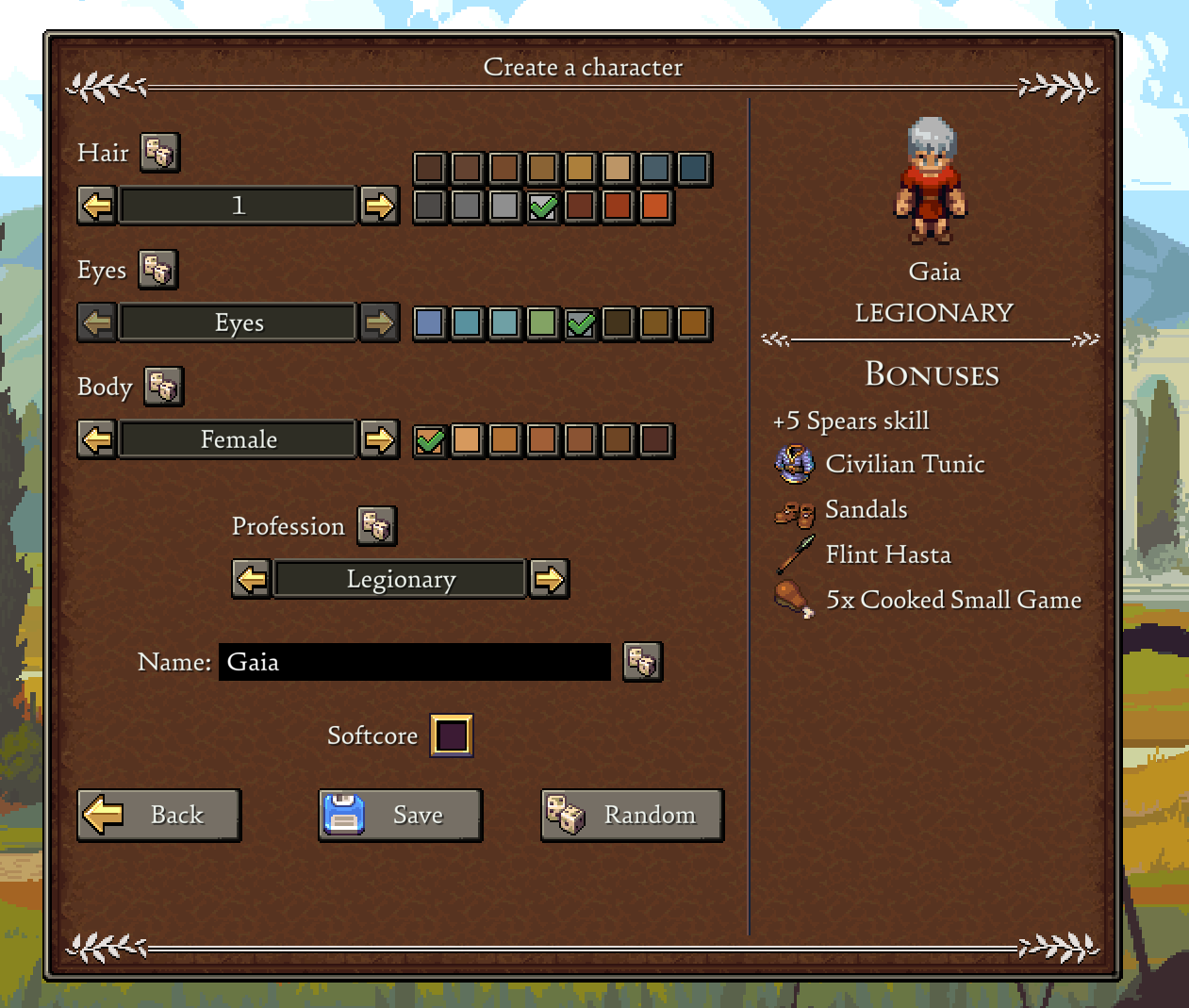
Every class starts with a Civilian Tunic and 5x Cooked Small Game, plus a +5 skill bonus and a thematic starting item.
| Class | Skill Bonus | Starting Item |
|---|---|---|
| Scholar | +5 Scrolls | Scroll of the Novice + Sandals |
| Legionary | +5 Spears | Flint Hasta (4-5 dmg, Fast) + Sandals |
| Gladiator | +5 Swords | Flint Gladius (3-4 dmg, Fast) + Sandals |
| Phalanx | +5 Shields | Wooden Shield (20 Block, 120°) + Sandals |
| Lobber | +5 Throwing | Wrist Wraps (Trinket: +1 Throwing Attack Power) |
| Woodcutter | +5 Woodcutting | Flint Axe (+5 Axe Power) + Sandals |
| Miner | +5 Mining | Flint Pickaxe (+5 Pickaxe Power) + Sandals |
| Mechanicus | +5 Construction | Workbench (placeable) + Sandals |
Scholar
Starts with the Scroll of the Novice, a ranged magic offhand. Tap for a primary attack, hold/charge for a heavier secondary. The main appeal: you can damage Fallen at distance while you're learning the dodge timing on melee. Full Scholar guide →
Legionary
Starts with the Flint Hasta, a spear (4-5 damage, Fast). Spears have more reach than short weapons in Romestead, which makes spacing more forgiving in melee. Full Legionary guide →
Gladiator
Starts with the Flint Gladius, a short sword (3-4 damage, Fast). Lower damage and shorter reach than the Hasta, but Sword skill scales differently and pairs well with a Shield offhand later. Full Gladiator guide →
Phalanx
Starts with a Wooden Shield (20 Block Strength, 120-degree block arc) as an off-hand item. The defensive starter. Shields in Romestead have angular coverage as a real stat — 120 degrees means roughly a third of your perimeter is covered when you block. Pair with a melee weapon you'll craft separately. Full Phalanx guide →
Lobber
Starts with Wrist Wraps (a Trinket: +1 Throwing Attack Power). No conventional weapon — the kit leans into the environmental-throws mechanic (pick up rocks, bushes, boulders and throw them for damage). Niche but interesting once you understand the throw system. Full Lobber guide →
Woodcutter
Starts with the Flint Axe (+5 Axe Power) and a bias toward lumber-gathering. Lumber is one of the most-consumed resources in the early-to-mid game, so the gather speed compounds across a run. Full Woodcutter guide →
Miner
Starts with the Flint Pickaxe (+5 Pickaxe Power) and a mining bias. Worth noting: the Miner profession is separate from a citizen's "Mining Job Level". Starting as a Miner doesn't change what you can mine — and you don't need it to: anyone can hand-mine Tin in the Desert with no level requirement at all. A Mining Job Level of 2 only matters for a Quarry citizen producing Tin Bars automatically. See our Bronze guide. Full Miner guide →
Mechanicus
Starts with a Workbench (placeable) in inventory plus +5 Construction skill. Skips the early grind of crafting your first Workbench from scratch. Good for builder-focused players who want to start placing buildings on minute one. Full Mechanicus guide →
Class picks for co-op
General principle: diversify. A 2-player party with one ranged (Scholar) and one melee (Legionary, Gladiator) covers more situations than two of the same. In 3+ player parties, add a Mechanicus to start with a Workbench, or a Phalanx to anchor defenses. Adding a Miner pushes your shared Tin/Bronze timeline faster.
Profession is largely a starting kit, not a permanent role. Every character levels skills based on activity, so a Scholar who chops wood for 10 hours becomes a serviceable lumberjack. Those skill levels also feed your Favour Points and the skill tree — the real long-term character progression. Don't overthink the starting choice.