Romestead Watermill Guide
Last updated: 2026-08-22
If your Watermill is sitting empty and you can't figure out why your wheat won't go in — or why it won't grind — you're in the right place. Romestead has two ways to turn wheat into flour, and one of them isn't available on day one. Here's the full picture: the wheat → flour → bread chain, the unlock, setup, the chest trick that gets it running, and how to fix it when it stalls.
On this page
The wheat → flour → bread chain
The Watermill is the middle link in Romestead's staple food chain. If you're really here because you want bread, this is the whole pipeline:
- Grow wheat — plant Wheat Seeds in a Farmstead. Note wheat can only be planted in the Plains biome.
- Mill wheat into flour — the Manual Mill (day one) or the Watermill (automated, this page).
- Bake flour into bread — the Bakery consumes flour (roughly 2 flour per Bread) plus Coal fuel. Bread is the most efficient way to feed your citizens.
Each link can bottleneck the next: no wheat means an idle Mill, and no flour means an idle Bakery. The Watermill exists to remove the milling bottleneck so the chain runs hands-off. The rest of this page is about getting it there.
Manual Mill vs Watermill
Both buildings do the same thing — turn wheat into flour, which the Bakery then turns into bread. The difference is automation.
| Building | Available | Operation | Throughput |
|---|---|---|---|
| Manual Mill | Day one (Infrastructure tab) | Player walks in circles around it to grind | Slow / hands-on |
| Watermill | After Ceres "Honoring the Craft" quest | Stock with wheat — auto-grinds over time | Fast / hands-off |
The Manual Mill is fine when you've got 10-20 wheat to grind. Beyond that you'll want the Watermill running — you can drop in a stack of 100 wheat and walk away.
How to unlock the Watermill
The Watermill is locked behind a Ceres quest called "Honoring the Craft", which you finish by performing an offering of crafted Bakery goods on Ceres's altar — so you need a functioning Bakery first. (People often search for this as a "craftsman offering." Worth knowing that Romestead also has a separately named Craftsman's Offering, which is an unrelated endgame ritual that opens the Temple of Vulcan — not this.) The progression chain is:
- Honoring the Soil (Ceres, 20 wheat) → unlocks Farmstead
- Fruits of the Harvest (Ceres, 5 Olives + 5 Pine Nuts + 2 Cabbage) → unlocks Bakery
- Build the Bakery, queue Emperor's Salad, Mushroom Skewer, and Bread
- Honoring the Craft (Ceres, offer those Bakery dishes on the altar) → unlocks Watermill
Full Ceres quest progression in our Ceres Quest Chain guide.
It only appears in the Infrastructure tab after Honoring the Craft is complete. If you're on a fresh world and don't see it, that's why — you haven't earned it yet. The Manual Mill is available immediately though.
Using the Manual Mill (day one)
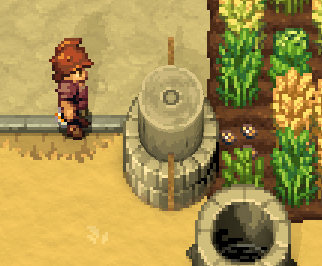
The Manual Mill is the grindstone-style building in the Infrastructure build tab. Once placed:
- Drop wheat into the Mill's storage.
- Approach the Mill and physically walk around it in circles — the player rotation drives the grinding.
- Each lap converts a quantity of wheat into flour.
It's tedious by design. The Manual Mill is the "you have no other option" bridge until the Watermill unlocks. Don't build more than one — you can only operate one at a time anyway.
Using the Watermill
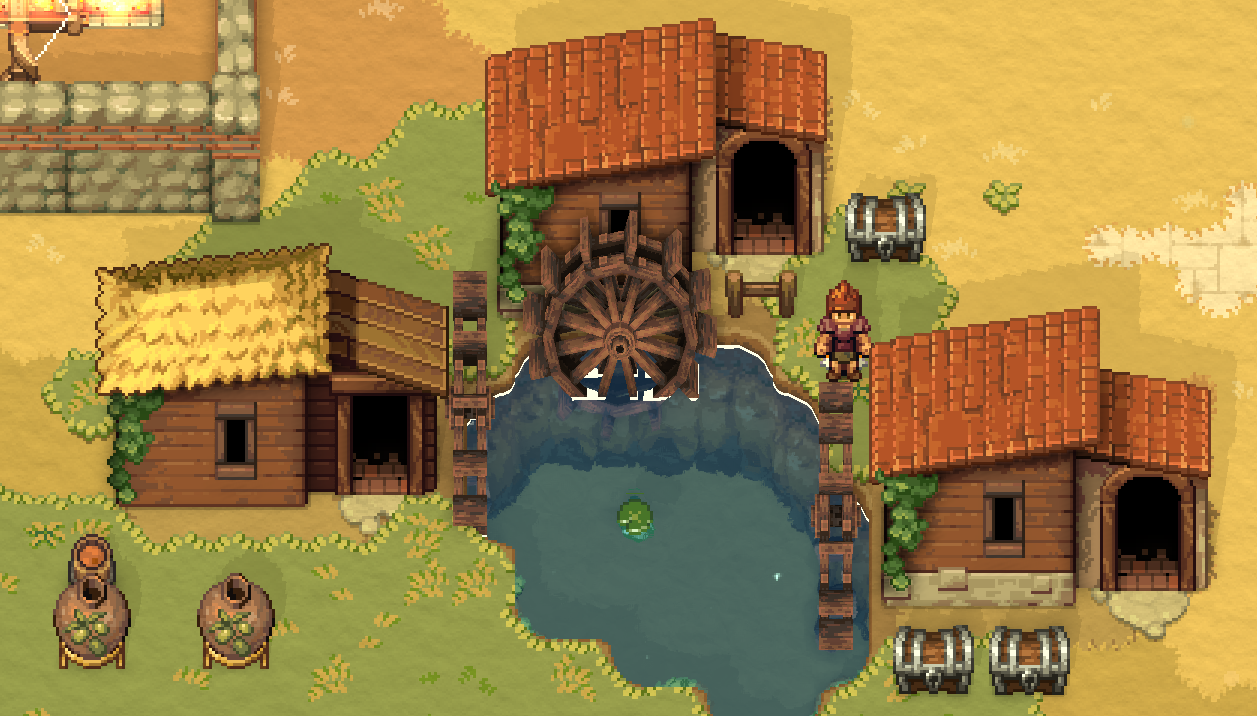
Once unlocked via Honoring the Craft, the Watermill — which players often call the water wheel or waterwheel, after the turning wheel that drives it — works automatically:
- Place the Watermill so its wheel sits in water — it doesn't need flowing water; any water works, even a small pond. Only dry ground fails.
- Stock it with wheat — you can drop stacks of 100 in at a time.
- The Watermill grinds the wheat into flour over time. No player interaction needed once stocked.
- Flour gets pulled by the Bakery for bread crafting.
This is where production stops being a chore and starts being passive. As long as the Watermill has wheat and the Bakery has flour, your bread supply runs itself.
Where to place the Watermill (and the desert question)
The Watermill isn't tied to a biome — it's tied to water. The only rule is that its wheel has to sit in water so it can turn. Crucially, it does not need to be running or flowing water — a river, a lakeshore, or even a small pond all work fine. The only placement that fails is dry ground. That single point is what trips most people up.
"Can you build a Watermill in the desert?" is a common question, because wheat farming keeps you in the Plains while mining and the Cyclops pull you into the Desert. The answer: yes, easily — since it doesn't need a flowing river, any water at the spot works, even a small pond or the edge of an oasis. So you can usually just mill right there in the desert. Only if there's genuinely no water at all near your outpost do you fall back to:
- Keep milling at your main Plains/river base and haul the flour (or finished bread) out to the desert. Your wheat only grows in the Plains anyway, so the farm lives back there regardless.
- Use a Manual Mill in the desert. It's player-powered, needs no water, and works anywhere — fine for the small batches a mining outpost actually needs.
The chest-outside staging trick
Here's the part the game doesn't tell you and that trips up most players: you can't place chests inside the Watermill. Same for the Tannery, Blacksmith, and other production workshops — the game blocks chest placement inside them.
But the Watermill's internal storage is small, and once it fills, the worker stalls. The fix:
Place a chest just outside the Watermill (one tile from the door is ideal). Stock it with wheat. Workers and the Mill pull from nearby storage as needed. This gives you a buffer well beyond the Watermill's internal capacity, and means you can drop 200+ wheat in one trip rather than constantly running back to refill.
Pro tip: if you've looted chests while exploring, you can break those chests and re-place them. No need to grind the Carpenter for fresh chests every time. The looted chest works exactly the same way.
Note: wheat is an inventory item, so chests work for staging it. Logs, stone, ore, and clay are carried items that won't go in regular chests at all — those need Material Storage. See our storage guide for the full rules.
Watermill Level 2 (directional variants)
Once you've courted Ceres far enough up her blessings tree, you can unlock Watermill - Level 2, which comes in four directional variants:
- Watermill - Level 2 (South)
- Watermill - Level 2 (West)
- Watermill - Level 2 (East)
- Watermill - Level 2 (North)
These appear to be placement variants for which side the wheel sits on — pick the variant that puts the wheel into the water at your build site. The Ceres blessing that unlocks them costs 3 Worship and lives in tier IV of her blessings tree. See the Gods guide for the tree layout.
Common questions
My Watermill isn't grinding even though it has wheat
Three things to check: (1) Is the wheel actually sitting in water? It doesn't need flowing water — even a small pond works — but on dry ground it won't turn. (2) Is there a worker citizen assigned? Like other workshops, it needs someone operating it. (3) Has the flour storage filled up? If there's nowhere for the flour to go, the Mill stops.
Can I put chests inside the Watermill?
No. The game blocks chest placement inside workshop buildings — including Watermill, Tannery, Blacksmith, Bakery, and the rest. Place chests outside the building entrance instead. Houses do accept chests inside them.
Can you build a Watermill in the desert?
Yes. The wheel just needs to sit in water — and it doesn't have to be a flowing river, so even a small pond or the edge of an oasis works. Find any water in the desert and you can mill right there. Only if there's genuinely no water nearby do you mill back at your Plains base (where your wheat grows anyway) or use a water-free Manual Mill for small batches.
Is the Watermill the same as the "water wheel"?
Yes — players often call it the water wheel or waterwheel because of the turning wheel that grinds the wheat. In-game it's the Watermill, with the Manual Mill as the day-one alternative.
Do Watermills need fuel?
No — the wheel uses water power, not fuel. The Blacksmith and Bakery need fuel (coal/wood) at their external furnace openings, but the Watermill doesn't.
Can I build multiple Watermills?
Yes — once unlocked, you can place as many as you want, each near a water source. Useful for high-throughput settlements where one Mill can't keep up with multiple Bakeries.
Is the Watermill better than the Manual Mill?
Strictly better, yes — throughput is higher and there's zero player interaction once it's stocked. The Manual Mill exists for the period before you've completed Honoring the Craft. Once the Watermill is up, you can demolish the Manual Mill if you want the space back.