Romestead Food Guide: Feeding Citizens & Stopping Starvation
Last updated: 2026-08-22
Citizens dropping dead while your farms are full of crops? You're not alone — it's the single most common Romestead complaint, and it's almost never a shortage of food. It's a delivery problem. This guide covers the real cause of starvation, exactly how much food your settlement needs, the most efficient food chain in the game, and the food items that secretly feed nobody.
Farmers and bakers stash what they make in their own building's storage. Citizens only eat from communal Food Storage. If you don't route food into communal storage, your people starve next to a full granary. That's the whole problem — everything below is how to fix it for good.
On this page
Why your citizens are starving
Romestead's food system has a delivery layer that the tutorial barely mentions:
- A Farmer harvests crops — into the Farmstead's own storage.
- A Baker bakes Bread — into the Bakery's own storage.
- Hungry citizens walk to communal Food Storage at meal time and eat from there.
Nothing automatically moves food from step 1/2 into step 3. Unless you set up that hand-off — haulers, a nearby Food Storage, or the Logistics Tent doing the routing — food piles up in workshops while citizens go hungry. This is the same root cause behind "my citizens are lazy" and "where did my food go": production without distribution.
Place a Food Storage building central to your housing and make sure food actually reaches it. Early on that means short manual/hauler trips — so keep the Bakery, Food Storage, and houses close together. Once you have the Logistics Tent, you can fully automate the hand-off: set it to move Bakery output straight into Food Storage and the starvation problem solves itself permanently — no more manual hauling.
How much food a citizen needs
Each food item has a Food value (the citizen icon + "X Food" on its tooltip) — that's how much hunger it restores when eaten at meal time. To plan supply:
- A baseline citizen needs roughly 9 Food per day.
- A citizen with the Gluttonous trait needs up to 14 Food per day — one of several reasons that trait is worth avoiding (see Citizen Stats & Traits).
Multiply by your population to size production. Ten ordinary citizens want ~90 Food/day flowing into communal storage — comfortably covered by a single Bakery running Bread once the chain is built.
Don't out-recruit your kitchen Every citizen you recruit is another mouth. Scale food production before you expand population, not after — a sudden recruit spree is a classic way to tip a stable town into mass starvation.
The bread chain (most efficient food)
Once you unlock the Bakery (via Ceres' Fruits of the Harvest quest), Bread becomes the most efficient way to feed a settlement for a very long time — it's cheap, scalable, and easy to mass-produce. The chain:
- Grow Wheat in a Farmstead — remember Wheat only grows in the Plains biome.
- Mill Wheat into Flour — the Manual Mill early, or the automated Watermill once unlocked.
- Bake Flour into Bread at the Bakery — baking consumes Coal as fuel, so keep the Bakery stocked.
- Route Bread to Food Storage so citizens can actually eat it.
Full milling mechanics are in the Watermill guide; the Ceres unlock order is in the Ceres Quest Chain.
Every Bakery recipe
The Bakery is far more than a bread oven — it's the full kitchen tier, where the Campfire is just basic early cooking. Its worker is a Baker (a high Job-Level cap — 4 at the base Bakery, and higher once you upgrade it; an upgraded Bakery's Baker can reach 7). The confirmed recipe list:
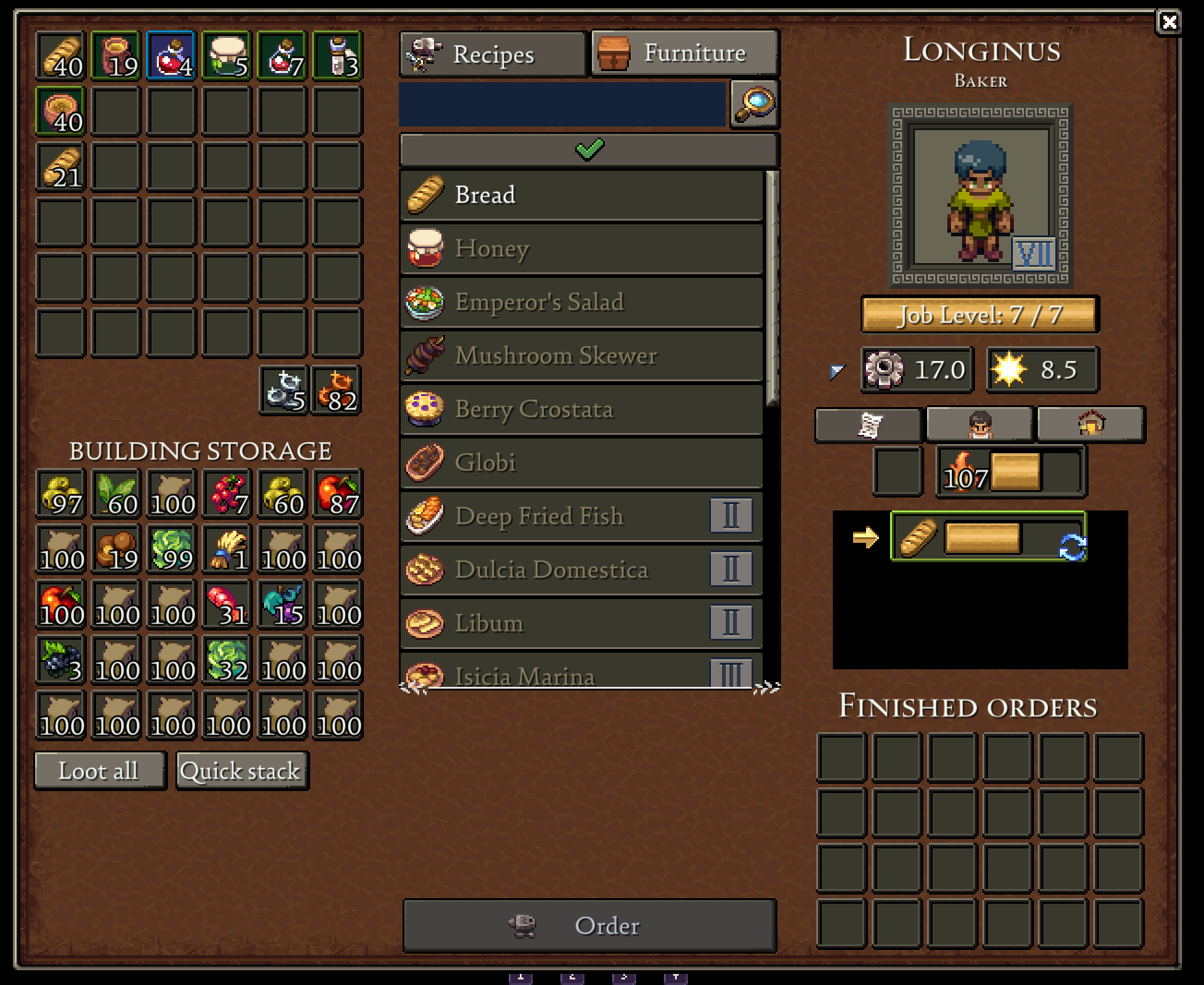
| Dish | Notes |
|---|---|
| Bread | The staple. Cheapest, most scalable food — the backbone of feeding any settlement. |
| Honey | Processed from honey combs (a Beehive produces combs steadily). |
| Emperor's Salad | A higher-tier prepared dish; also used as a Ceres altar offering in the quest chain. |
| Mushroom Skewer | Mushroom-based dish; another Ceres offering option. |
| Berry Crostata | Roman-style berry tart. |
| Crab | Seafood dish — needs crab meat from coastal/water sources. |
| Deep Fried Fish | Fish + Olive Oil. Fish is bought from a Market merchant — you can't catch it. |
| Dulcia Domestica | An authentic Roman dessert (stuffed dates) — gourmet-tier food. |
| Allium | Onion-based dish. |
| Sausage | Added in Beta Branch 0.25.2_2 (June 2026) — a meat-based Bakery dish. |
For everyday feeding, Bread does the heavy lifting. The fancier dishes matter for altar offerings (several Ceres quests want specific Bakery dishes) and for higher Food values per item. Exact ingredient lists and Food values are being catalogued as the game updates — we'll add them here as they're confirmed.
Buff foods & the zero-value trap
Two things most players miss:
Buff foods reduce consumption. Some foods do more than fill the hunger bar. Chicken of the Woods (a mushroom) applies a Satiated effect: −20% overall Food cost. Feeding buff foods can meaningfully shrink how much your settlement eats — a real economy lever, not just flavour.
Some items your citizens will happily eat have a Food value of 0 — notably raw Olives and Blackberries. If these sit in communal Food Storage, citizens consume them at meal time and they vanish without restoring any hunger. Keep zero-value ingredients out of Food Storage (send Olives to the olive oil chain instead) so your people eat the food that actually feeds them.
Fishing & fish — the honest answer
You cannot fish in Romestead. There is no fishing rod, no bait system and no fishing mini-game in the current Early Access build. If you've read otherwise, you've almost certainly read a guide that confused Romestead with a different game — and we'll own that we ran an inaccurate version of this section ourselves before checking it properly.
Beartwigs answered this directly in their roadmap post: "Are there any plans to add fishing as a gameplay activity? It's a classic activity that many players love, so we'd definitely love to add it down the line. However, right now we are prioritizing features that are uniquely Roman and lean into our specific setting. Because fishing is a more generic mechanic, it's currently lower on our priority list while we focus on the core identity of the game."
So: wanted, acknowledged, and explicitly not a near-term feature. It is not in the Autumn Update either.
Then why are there fish, ponds and worms?
Because the game has the ingredients of fishing without the activity, which is exactly why everyone assumes it's implemented:
- Fish exists as an item and feeds real recipes (below).
- Ponds visibly contain fish. You can watch them. You cannot catch them.
- Worms drop — most commonly from the Clay Pit, and from worms in the Plains. As of now they have no confirmed use whatsoever. The community consensus is that they're groundwork for a future system. Don't hoard them expecting a payoff, and don't believe any guide that tells you they're bait.
How to actually get fish
One way, and it's reliable: buy it from a Market merchant.
| Source | Where | Cost | Requirement |
|---|---|---|---|
| Market merchant | Markets in the Plains and Forest biomes | 1 Denarius 50 Quadrans | Merchant rank 2 |
The Market itself is unlocked by the Art of Trade quest. Merchant stock is biome-specific, so a desert merchant won't stock fish no matter how long you wait — you need a Plains or Forest market. Levelling a merchant to rank 2 is the gate, and the fastest way to do that is the buy-for-XP trick in our money & trading guide (selling earns coin but no merchant XP; buying is what levels them).
Practical consequence: fish is a purchased ingredient, bought a unit at a time, not a farmed one. Plan any fish recipe around a shopping trip and a stocked coin purse rather than a supply line.
What fish is for
- Garum — the Roman fermented fish sauce, made in a Garum Dolium. Garum then feeds a further set of higher-level Bakery dishes, so it's the reason fish matters at all beyond a single meal.
- Deep Fried Fish — a Bakery dish combining Fish with Olive Oil. See the Bakery recipe list above and our olive oil guide for the oil side of it.
Because every fish is bought, treat both as occasional buff food for a boss run rather than a staple. Your day-to-day calories should come from the bread chain, which scales and costs nothing but wheat.
The set-and-forget food setup
Once you've got the Bakery, this layout keeps a town fed with almost no micromanagement:
- A Farmstead with its plots filled entirely with Wheat (don't mix in other seeds — you want flour throughput).
- A Watermill next to it converting Wheat → Flour automatically.
- A Bakery beside the Mill with an infinite/repeating Bread order queued and a stack of Coal (e.g. 99) loaded as fuel.
- A Food Storage the Bakery feeds into, central to your houses.
- The Logistics Tent automating the deliveries — crucially, moving the finished Bread from the Bakery into Food Storage for you, plus feeding wheat and flour along the chain so nothing stalls at a full internal storage.
Build that once — with the Tent handling the Bakery→Food Storage transfer — and bread flows from field to table on its own. From there you only intervene to scale up before recruiting more citizens.
Common questions
Why are my citizens starving when I have plenty of food?
Because the food is sitting in the Farmstead's or Bakery's own storage, not in communal Food Storage. Route it there with haulers, carts, or the Logistics Tent. Citizens only eat from communal storage.
How do I automate moving food into storage?
Use the Logistics Tent. Once you've unlocked it, you can set it to move Bread from the Bakery directly into Food Storage automatically — that removes the manual hauling that causes most starvation. Before the Tent, you're reliant on haulers/carts and short distances, so keep the Bakery and Food Storage close together.
What's the best food to feed citizens?
Bread. It's cheap, scales easily, and stays efficient for most of the game. Build the wheat → flour → bread chain and queue an infinite Bread order.
How much food does each citizen need?
About 9 Food per day for a normal citizen, up to 14 for a Gluttonous one. Multiply by population to size your Bakery output.
My citizens eat Olives/Blackberries but stay hungry. Why?
Those have a Food value of 0 — they get eaten but restore no hunger. Keep them out of Food Storage and process Olives into olive oil instead.
Can you fish in Romestead?
No. There's no fishing rod, no bait system and no fishing mini-game — even though ponds visibly contain fish. Beartwigs addressed it in their roadmap: they'd like to add it eventually, but because fishing is "a more generic mechanic" rather than a distinctly Roman one, it's "currently lower on our priority list." It is not in the Autumn Update. See the full explanation above.
How do you get fish in Romestead?
You buy it. Fish is stocked by Market merchants in the Plains and Forest biomes for 1 Denarius 50 Quadrans, and needs a merchant at rank 2. Desert and volcanic markets don't stock it. Fish feeds Garum (via a Garum Dolium) and Deep Fried Fish at the Bakery.
What are worms for?
Nothing, yet. Worms drop from the Clay Pit and in the Plains, but they have no confirmed use in the current build — and they are not fishing bait, because there's no fishing. They're widely assumed to be groundwork for a future system. Don't stockpile them expecting a payoff.
Does the Bakery need fuel?
Yes — baking consumes Coal. Keep a stack loaded or the Bakery stalls. (The Watermill, by contrast, runs on water and needs no fuel.)