Romestead Citizen Stats & Traits Guide
Last updated: 2026-07-20
Open any citizen's panel and you get a six-cell grid of icons, a Job Level, a list of skills, and a row of traits — and the game explains almost none of it. Here's what each stat actually means, how leveling works, why your best worker has a "Disloyal" tag, and the one decision that trips up every new settlement: upgrade the building or recruit another citizen?
On this page
The 6-stat panel
Every citizen shows the same six-icon stat grid. The icons are never labelled in-game, so here's what each one is — values in the "Seen" column are the real ranges we've observed across workers of different levels.
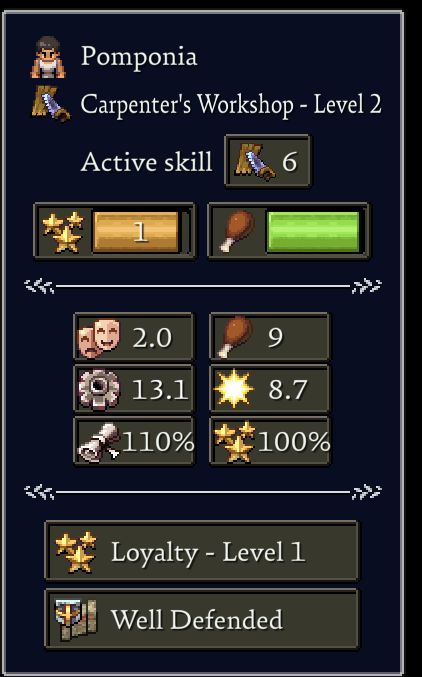
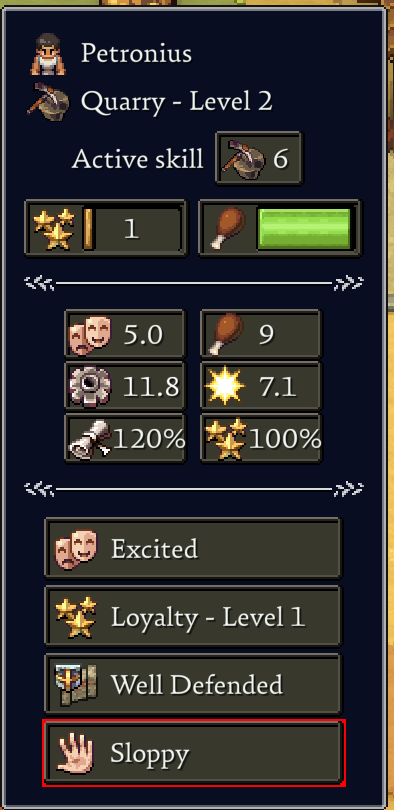
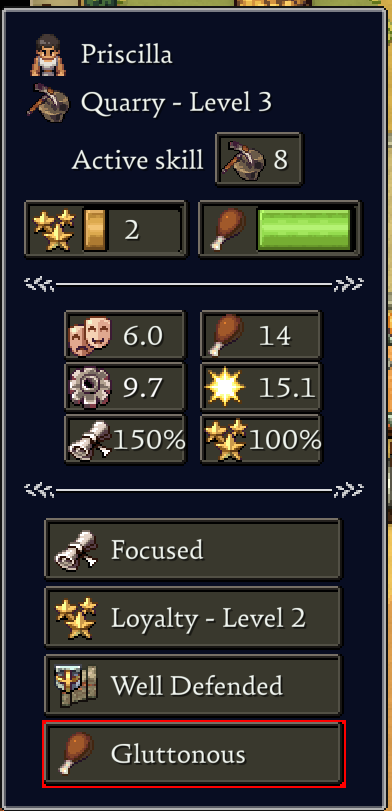
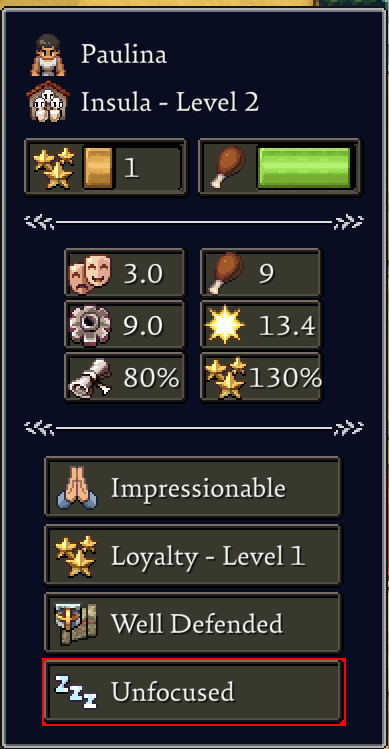
| Icon | Stat | Seen | What it means |
|---|---|---|---|
| Theatre mask | Mood multiplier | 1.0–2.0 | A baseline multiplier that buffs/debuffs modify — we've seen it at 1.0 and rise to 2.0 on a content, well-supported citizen. |
| Drumstick | Food / Satiety | 8–9 | How well-fed the citizen is. Fed by pure "Food" items at meal time (not Olives/Pine Nuts). |
| Wheel / cog | Work Speed | 9–17 | How fast they complete jobs. Scales with Job Level — a level-4 worker hit 17.0. |
| Sun | Energy / Happiness | 6–16 | Mood/energy. Raised by buffs like Wine's "High Spirits." |
| Scroll (%) | Work Quality | 70–105% | Output quality of what they craft. |
| Star (%) | XP progress | 50–100% | Progress toward the next Job Level. |
Romestead doesn't label these icons and the devs haven't published a stat reference, so the names above are our best read from watching the numbers move (e.g. the cog clearly tracks Job Level). The behaviour is reliable; the exact labels may differ from the eventual official wording. We'll firm this up as the game documents itself.
Job Levels & the Roman-numeral badge
Each citizen has a Job Level for the work they're assigned, shown as X / Y — current level over the building's current max. The denominator is set by the building, not the citizen.
- Citizens gain Job Experience by doing the work. XP-to-next-level scales sharply (we've seen 196 XP at a mid-tier level, 384 at a higher one).
- Higher Job Levels mean faster work and unlocked recipes at that workshop — the game states it directly: "Higher level citizens work faster and unlock new recipes."
- When a worker maxes out, you'll see: "Max job level reached for this building. Upgrade the building to increase the max job level."
- The small Roman-numeral badge on the portrait (II, III, IV…) is a quick at-a-glance read of their level.
Because the cap belongs to the building, leveling and building upgrades are tightly linked — the full mechanic is in our Building Upgrades & Job Levels guide.
Multi-skill citizens
Citizens aren't locked to one job. The panel shows an Active skill (current job + level) and Other skills (jobs they've trained before).
When you reassign a citizen, their old job XP is retained, not lost. One observed worker (Laelius) ran Lumber Yard 2 as active with Carpenter's Workshop 2 banked as an "Other skill." You can shuffle citizens between buildings as your needs change and pick up right where they left off — useful for covering a temporarily empty workshop.
Traits
At the bottom of the panel is a row of traits. Positive traits show in blue/green; negative traits get a red border. Most citizens carry a mix — expect at least one negative on nearly everyone.
| Positive (confirmed) | Negative (confirmed) |
|---|---|
| Meticulous | Sloppy |
| Quick | Unfocused |
| Well Defended * | Disloyal |
The pairs read as direct opposites — Meticulous/Sloppy likely push Work Quality, Quick/Unfocused likely push Work Speed, and Disloyal works against loyalty/happiness. * "Well Defended" appeared on multiple unrelated citizens at once, so it may be a settlement-wide condition rather than a personal trait.
A "Disloyal" or "Sloppy" tag on an otherwise good worker isn't a reason to bench them — Job Level gains dwarf trait effects, and a leveled worker with a bad trait still out-produces a fresh recruit with good ones. Match traits to roles when you have the luxury (Meticulous on a Blacksmith, Quick on a gatherer), but level first.
Loyalty & happiness — keeping citizens content
Romestead doesn't show a single labelled "loyalty" bar — the closest thing is the Sun cell on the citizen panel (Energy / Happiness, roughly 6–16). A few confirmed levers move it in the right direction:
- Keep them fed. A settlement that runs out of food is the fastest way to sour your citizens — see the Food guide for why they starve next to full farms and how to fix it.
- Use the "High Spirits" buff. Wine grants a High Spirits mood boost that raises the Happiness/Energy cell — the Gods guide covers the Wine chain and its tradeoff.
- Don't panic over a "Disloyal" tag. It's a trait that nudges against loyalty, but Job Level gains dwarf it — a leveled worker with a Disloyal tag still out-produces a fresh loyal recruit. Level first, match traits later.
Honest note Romestead only partly surfaces its loyalty/happiness system in Early Access. The levers above are the confirmed ones; we'll expand this as the mechanic gets clearer in-game.
What citizens actually do
A lot of guides claim Romestead citizens forage and gather on their own. They don't — but they're not statues either.
- They do walk between their workshop and storage buildings to fetch their own inputs and deposit outputs — they're "job-zone mobile."
- They do work jobs you queue: a Baker bakes, a Farmer tends crops, a Carpenter set to "Constructing" walks to Material Storage and builds your queued placements.
- They do not roam the wilds to forage or scavenge.
- They do not auto-craft without an order, and each workshop caps at a 10-job queue (until the Logistics Tent's "Repeat" orders — see Automation).
- They do not auto-haul raw logs/stone/ore from gathering buildings to Material Storage — that's you (or a Wooden Cart route).
The takeaway: the player is still the main hauling loop in the early game. Full breakdown in our Automation guide.
Upgrade the building vs recruit a new citizen
The most common settlement mistake is stuffing a second worker into a workshop that just needs an upgrade. Use this:
- Worker is capped (e.g. 3/3): upgrade the building. A second citizen here caps at the same level and just splits the XP.
- Worker is mid-level (e.g. 2/4): let them grind. Adding a second worker now slows both of them down by splitting XP.
- You need a job nobody is doing: recruit — but fill one worker per workshop to cap before adding a second.
Since the level cap is a building property, "my worker won't level past 3" almost always means "upgrade the building," not "recruit better people." See Building Upgrades.
Recruiting & sacrificing citizens
You recruit citizens from camps out in the wild (the "Populating Your Town" tutorial quests walk you through your first ones). Citizens use authentic Roman names — Cloelius, Pomponia, Longinus, Laelius.
There's also a darker option: the altar's Sacrifices tab lets you sacrifice a citizen to a god. It's permadeath for that citizen, presumably in exchange for a large worship boost or unique reward — the exact payoff is still being documented. Very on-theme for a Roman setting. More in the Gods Guide.
Romestead is in Early Access. Stat labels, trait effects, and the sacrifice mechanic are still being confirmed in-game; we flag what's observed vs interpreted and update after each patch — see the patch tracker.