Romestead Automation Guide
Last updated: 2026-08-23
If you've been frustrated that Romestead has no auto-collection from Lumber Yards, no output chest on watermills, and no infinite production queue — you're not crazy. Real automation is gated behind a boss drop most players don't know about. Here's when it unlocks, how to use it, and what to do until then.
On this page
The TL;DR
- Romestead's "automation" is more limited than the genre usually implies. Set expectations correctly.
- Citizens are job-zone-mobile but don't roam. They walk between their workshop and storage buildings as part of their job — they do NOT forage the wilds.
- Each workshop caps at 10 queued jobs. No "queue 100 bread and walk away for hours."
- Wooden Carts are day-one accessible for 3 Lumber from the Infrastructure tab. Hold 4 resources, chainable.
- The Logistics Tent — as of patch 0.25.1_7 (June 1, 2026) — now drops from the Guardian of Minerva (Owl), not Pyzifax. The scaled-up auto-routing + repeatable-orders layer.
- The Lumber Yard auto-collects from trees (no roaming required), but only into a 3-log internal buffer — player or carts must haul to Material Storage from there.
Where automation comes from
Most online guides oversell what Romestead's automation actually does. The honest picture:
Lumber Yard auto-production
The Lumber Yard auto-produces logs into its 3-log internal buffer. Importantly: it does NOT actually cut down nearby trees. Logs spawn into the building's storage; surrounding trees stay standing. What tree proximity does is speed up production — the more trees within the Yard's radius, the faster logs are produced. Trees are a multiplier, not a resource.
The buffer is tiny (3 logs) and citizens don't auto-transfer logs to Material Storage. You haul the logs (or a Wooden Cart route does, post-Logistics-Tent). Adjacency to Material Storage just shortens the carry distance.
Carts are the other half of the answer, and they're available immediately — see Wooden Carts below.
Logistics Tent (post-Owl, as of 0.25.1_7) — the real automation unlock
Important patch change: as of June 1 patch 0.25.1_7, the Logistics Tent now drops from the Guardian of Minerva (Giant Owl) — the day-one progression-gate boss — not Pyzifax. This means full automation is now accessible MUCH earlier than it used to be. The in-game tooltip:
"Unlocks logistics for the town. Logistics allow you to create connections between buildings and infrastructure to automatically transfer goods. Also unlocks the ability to have repeatable work orders."
So it does two huge things at once:
- Pipe connections between buildings. You can wire one building's output directly to another building's input. Watermill flour → Bakery. Farmstead wheat → Watermill. Whole chains run hands-free.
- Repeatable work orders. Every workshop now has a "Repeat" checkbox on each queued recipe. The in-game tooltip: "If enabled, this order will be repeated until manually cancelled." Set Bread to Repeat and the Bakery keeps making bread forever — the 10-job queue cap stops mattering.
This is the single biggest economy upgrade in the game. Pre-Tent, you're constantly visiting workshops to re-queue. Post-Tent, set your chains once and the settlement runs itself.
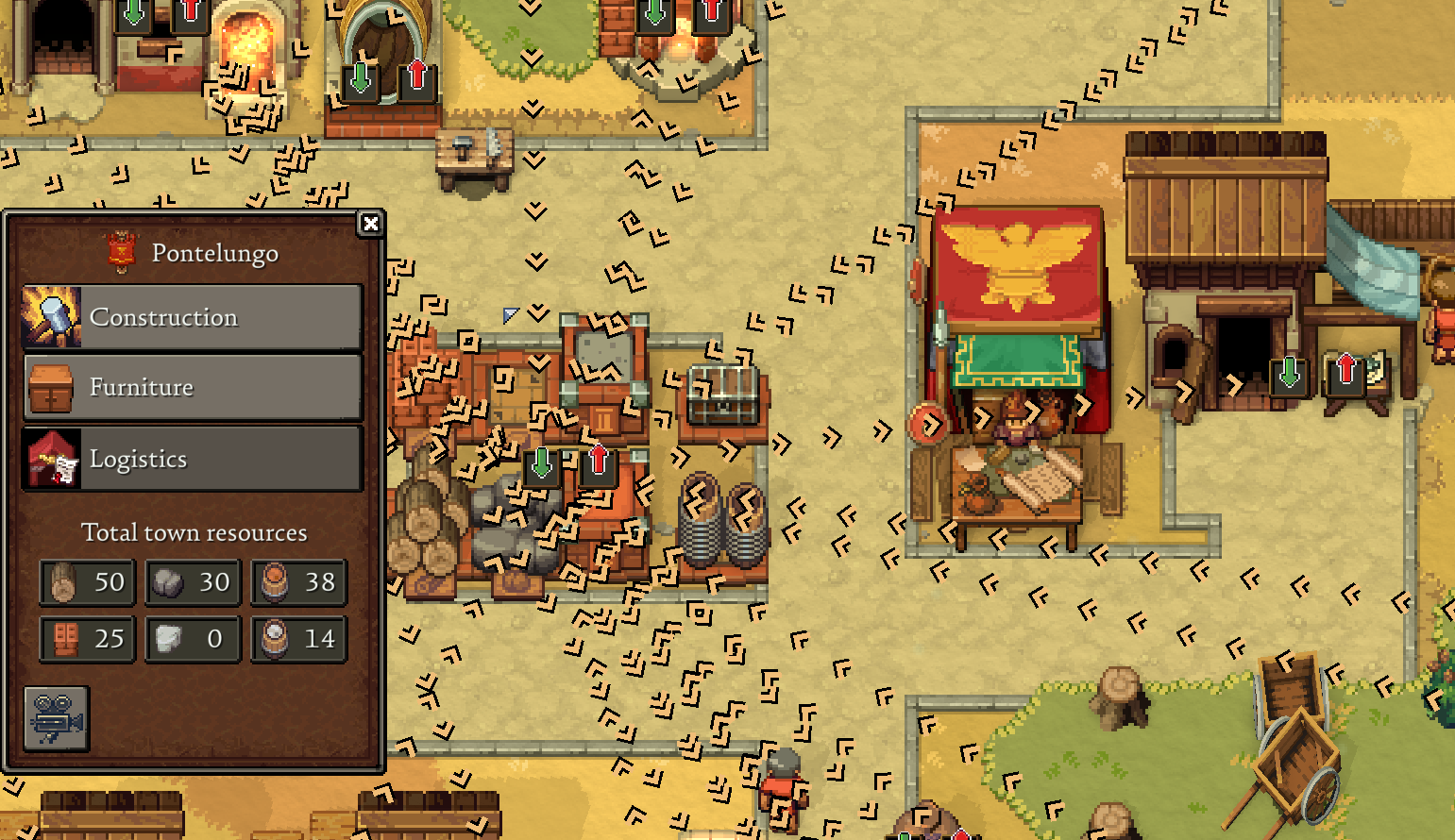
Design-wise, Beartwigs gates the quality-of-life unlock behind real combat progression. Wooden Carts let you survive without it; the Tent is the upgrade that turns your base from "managed chaos" into a self-running production engine. See our Pyzifax boss guide for the fight itself.
Wooden Carts & chaining carts together
The Wooden Cart is Romestead's first automation tier, and almost nobody realises it's available on day one. It's in the Infrastructure tab for 3 Lumber each — no Carpenter's Workshop required. (A parallel path exists at the Carpenter's Workshop for 12 Wood Plank — same item, different materials. Use whichever fits your supply.)
The in-game tooltip is the part worth reading twice:
"Holds up to 4 resources. Can be connected into a chain with other carts. Used for transporting multiple resources at once."
Chaining carts together
That middle sentence is the hidden mechanic: carts connect to each other. Rather than one cart shuttling 4 resources, you link several into a train and move the whole load at once. In practice we place them vertically, one behind the other, along a road between the gathering area and Material Storage — two linked carts carry 8 resources, three carry 12, and so on.
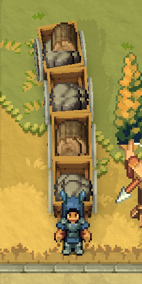
This matters most for carried items — logs, stone, ore and clay — which you otherwise haul one at a time over your shoulder and which can't go in chests at all. A cart chain running from your Lumber Yard or quarry to Material Storage is the single biggest quality-of-life win available before you beat the Owl.
Increase your cart capacity
Carts get better permanently. Mercury's Increased Cart Capacity blessing adds +1 capacity to all carts for 3 Worship — so every cart you own goes from 4 to 5, and a three-cart chain jumps from 12 to 15 in one purchase. It's retroactive across your whole fleet, which makes it far better value the more carts you run. Full blessing list in the gods guide.
Carts vs the Logistics Tent
They solve different problems and you want both. Carts are physical objects you place and fill — a bigger bucket, still moved deliberately. The Logistics Tent is the real automation layer: it auto-routes goods between buildings without you touching them. Carts get you through the early game; the Tent is what makes the base run itself. Since patch 0.25.1_7 the Tent arrives much earlier than it used to (see below), but carts remain useful for the bulk carried-item runs the Tent doesn't cover.
What citizens actually do (and don't)
This is the single most-misrepresented mechanic in online content. The honest reality:
- Citizens walk between their workshop and storage buildings to fetch inputs for their craft orders. They're not stuck at their workshop.
- Carpenter with "Constructing" job toggle ON will walk to Material Storage, grab building materials, and deliver them to queued construction sites. With the toggle OFF, you haul materials yourself.
- Citizens do NOT roam the map to forage, scavenge, or gather raw resources. They don't chop trees on their own (the Lumber Yard's lumberjack does, but only within the Yard's defined behavior).
- You must visit each workshop and queue orders manually. No global production queue.
- Each workshop holds a maximum of 10 queued jobs. Want 50 bread? Queue 10, wait, queue 10 more.
Net effect: the player remains a significant part of the gathering and hauling loop. Romestead is not RimWorld. Setting expectations correctly here prevents a lot of frustration.
Manual workarounds before either automation tier
Before you've crafted Wooden Carts and before Pyzifax, here's how to keep your base running:
1. Place storage right next to producers
Citizens walk to the nearest valid storage when their building is full. A storage chest one tile from the Lumber Yard means a 1-tile walk; a storage chest across the settlement means a 30-tile walk. Adjacency is the cheapest "automation" you can build.
2. Use dedicated job assignments
Every citizen has a job priority. A citizen assigned only as a Lumber Yard worker will spend 100% of their day on lumber. A citizen assigned to three jobs will switch every few in-game hours and waste travel time.
3. Stockpile inputs ahead of time
If your Bakery needs flour, hoard 50 wheat before you build the Bakery, mill it all at once, and dump the flour in storage. Less constant pulling.
4. Cluster workshops
Crafting Bench, Blacksmith, Leatherworker, Carpenter — put them in one tight cluster. Citizens with multiple job slots will walk less. Repeats the principle from our build order guide.
The Watermill chain (and others)
Once you have the Logistics Tent placed, these are the chains worth wiring first:
Watermill → Bakery → Food Storage
Wheat goes into the Watermill (or Manual Mill if no river), becomes flour, flour goes to the Bakery, bread goes to Food Storage. With the Logistics Tent, no manual hauling needed — you'll always have bread.
Olive Grove → Pottery → Dolium
Olives become olive paste, paste plus empty pots in the Dolium becomes olive oil. Olive oil is a high-tier food/buff item. Full chain detailed in our olive oil guide.
Mine → Smelter → Blacksmith
Copper and Tin ore route to the Blacksmith for smelting, then to the crafting queue for Bronze gear. Big quality-of-life win once you're farming the desert for Tin. See our Bronze guide.
Post-Logistics Tent layout principles
- Place the Tent centrally within your production cluster — the building reportedly has a working range, so closer buildings route faster.
- Producer → consumer adjacency. Even with automation, shorter chains are faster.
Common automation questions
Wooden Carts vs Logistics Tent — what's the difference?
Wooden Carts are physical objects you place. They hold 4 resources each and can be chained for bulk transport along a route you set up. The Logistics Tent is more like a network controller — it auto-routes resources between buildings in its range. Use carts for early hauling, the Tent later for full hands-off production.
Where does the Logistics Tent come from now?
As of patch 0.25.1_7 (June 1, 2026), the Logistics Tent drops from the Guardian of Minerva (Giant Owl). Previously it dropped from Pyzifax. If you've already cleared the Owl on a fresh world post-patch, you should have access — check your build menu.
Does the Logistics Tent replace citizens?
No. It moves resources between buildings — production still requires assigned workers. (Higher Job Levels make those workers faster and unlock new recipes; see our Building Upgrades guide.)
Why don't my Lumber Yards seem to keep up?
The Lumber Yard auto-produces logs into its internal storage — but note it does NOT actually cut down trees in the world. Logs spawn from thin air at the building; nearby trees just speed up the production rate. The bottleneck is the internal storage caps at 3 logs. Once full, production stops until the buffer is emptied. Since logs are carried items that don't fit in regular chests, you need to manually haul them to a Material Storage building (or set up a Wooden Cart route). Place a Material Storage adjacent to the Yard to minimize the carry distance. Full storage rules in our storage guide.
Why does my Blacksmith / Bakery sit idle?
Both buildings need fuel (wood, coal) added at the external furnace opening on the OUTSIDE of the building. Without external fuel, they don't work even if all the recipe ingredients are stocked. For the Blacksmith specifically, ore goes in the same external furnace location as the fuel and converts to ingots in about 15 seconds.